
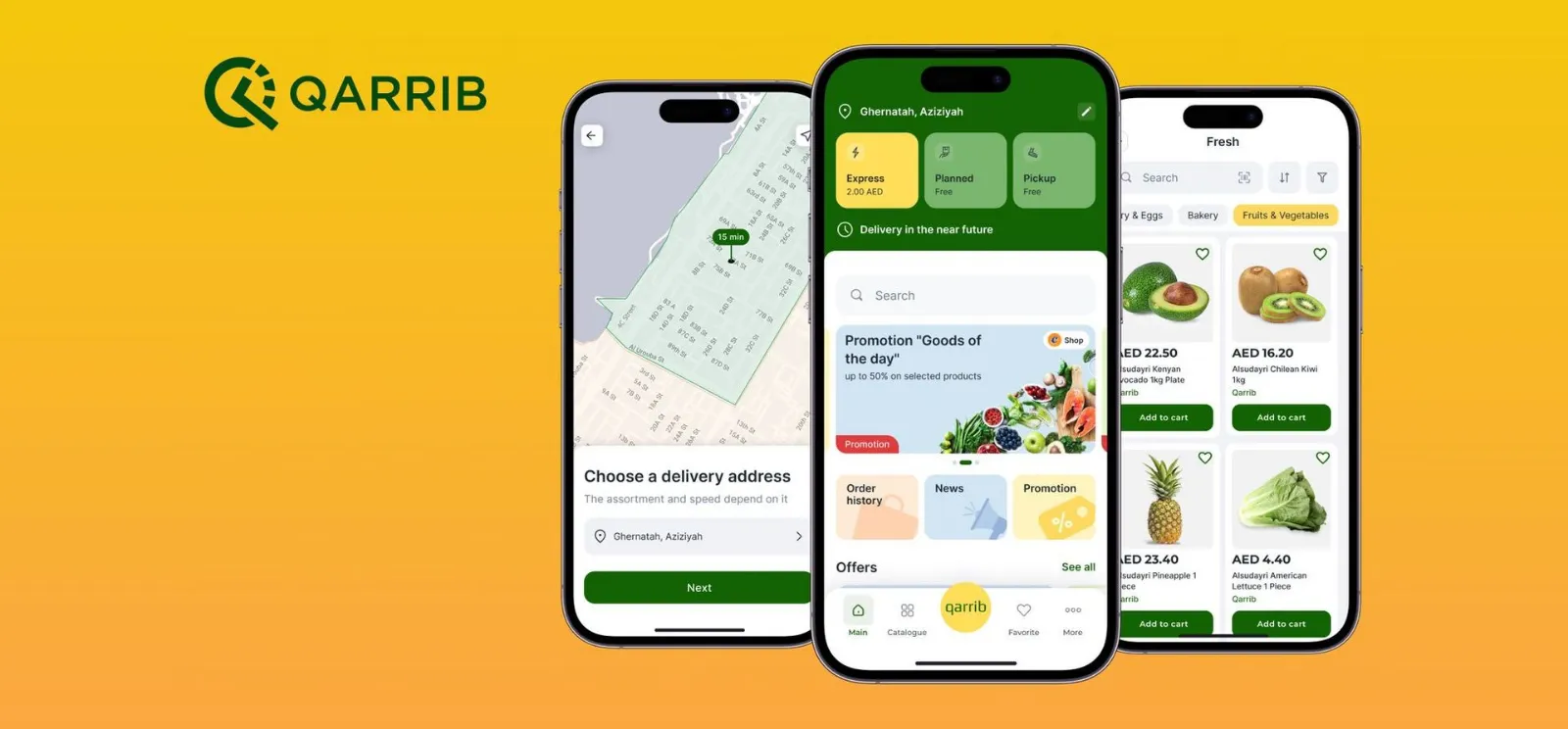
The client planned to enter the everyday goods market in several countries of the region at once, with a market potential of over 15,000 stores. The marketplace model: the buyer orders in the app, and one of the partner stores or the chain's own outlet fulfills the order. A launch like that has to solve several problems at the same time.
Three country instances on one product
We built the platform as three standalone country systems assembled from a single codebase. The instances are deployed and updated centrally, from one template.
What sets the region apart
Some of the solutions had to be built for the region.
Each country in its own system, the code is shared
Each country is a separate database, a separate domain, its own stores, delivery zones, currency and payment settings. A change in one country doesn't touch the others. Code, updates and support are shared.
Orders, stores and commissions in one loop
One order, three stores, one fulfiller
All the marketplace's stores see the order. Whoever takes it first picks it, and the others see that another store has already accepted it. A picked order goes into the partner commission calculation.
What is implemented in the system
Every system in its place
The accounting core, the app backend, the payment provider and the communication services exchange data so that the buyer sees current products and stock, and the order lands in the records at once.
What we can confirm
The client's market potential is over 15,000 stores.
How it is built
Three layers per country. Odoo 14 handles products, money, the warehouse and commissions. A separate backend serves the apps: it holds the catalog, search, carts and sessions, and exchanges data with Odoo through a message queue that logs every message.
The Android and iOS apps work through the backend API. All countries are deployed from one template with an automated tool.
From launch to the third country
Who this solution suits
We'll show it on your marketplace's processes
We'll take your process from order to handover and show what standard Odoo covers and what is really worth customizing.
We will get back to you promptly to agree a demo time.