

What is Odoo?
Odoo (formerly known as OpenERP) is an open-source modular ERP system that unites all core business functions on a single platform. It's like assembling a puzzle — you choose only the modules you need right now and build your own system tailored to your unique needs.
According to our clients, managing a business today is like juggling processes, tasks, and deadlines: clients calling, warehouse confusion, accounting discrepancies. Ten years ago, small and medium-sized businesses used dozens of separate programs: one for CRM, another for warehouse, a third for finance. And the result? Data chaos, manual data entry errors, lost time and money.
Odoo was created specifically to solve this problem — a comprehensive management system that united all business processes in a single digital space, interacting with each other in real time. In this article, we'll explain in detail what Odoo is, what capabilities this system has, and why tens of thousands of companies worldwide choose it.
A Bit of History
Odoo emerged in 2005 in Belgium as OpenERP — the team decided to create an ERP system that wouldn't cost an arm and a leg and would be flexible and understandable. In 2014, the company changed its name to Odoo and significantly expanded functionality, adding modules for e-commerce, marketing, HR, and much more. Today, Odoo is used by over 15 million users in 120+ countries worldwide. A global community of over 100,000 developers around the world improves and expands the platform's capabilities.
Odoo's Reputation
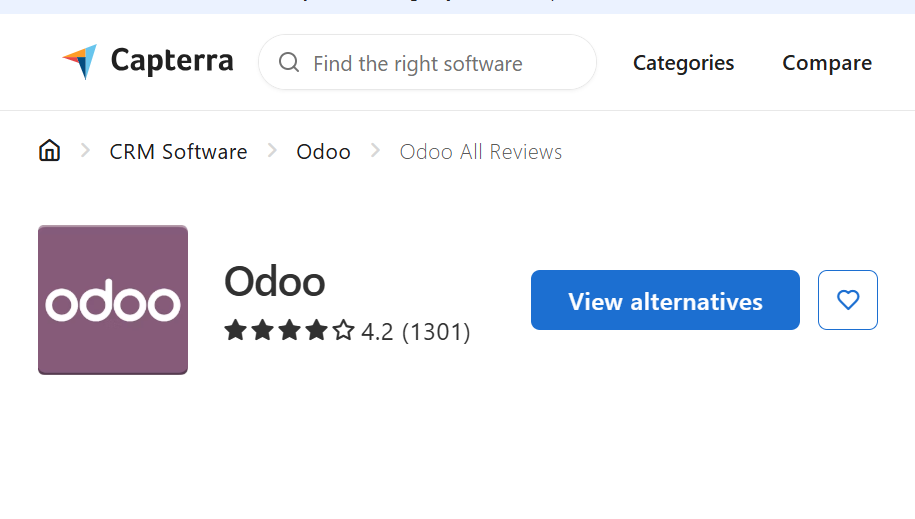
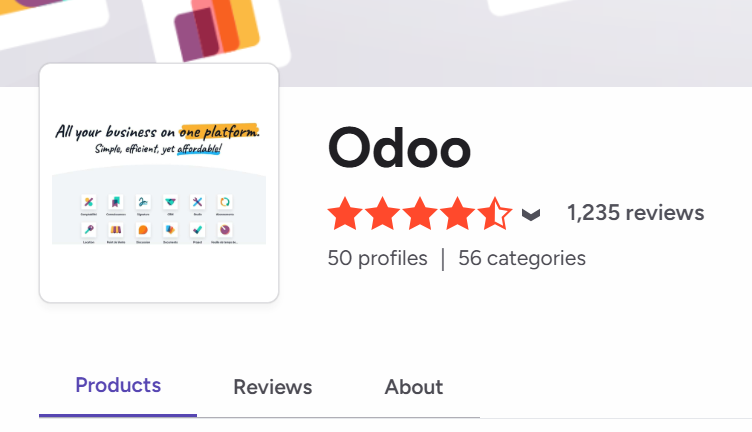
A few words about what professionals and service users think. Currently, Odoo has a good reputation as one of the most dynamic and accessible ERP systems in the world. Users often praise Odoo on online review platforms. For example, on Capterra the average rating is around 4.2/5 (based on over 1,300 reviews), on G2 — around 4.3/5, and consumers highlight advantages such as: modularity, flexibility, user-friendly interface, and excellent price-quality ratio.
Business and IT publications often position Odoo as one of the best alternatives to traditional expensive ERP systems (SAP, Oracle, Microsoft Dynamics) for small and medium-sized businesses. The platform has gained recognition for its innovative approach, rapid development, and scalability — from startup to large enterprise. Odoo has repeatedly made it to the top best ERP solutions in reviews by TechDogs, LinkedIn Top 10 ERP, analyst Forbes Advisor, current trends LiveBusiness and other specialized resources. Additionally, the company actively develops a partner network worldwide and annually holds Odoo Experience — one of the largest ERP conferences in Europe.
Thanks to open source code, regular updates, and a strong community, Odoo has earned the status of a modern, reliable, and promising system chosen by companies around the world.
ERP Odoo: Key Modules for Business Automation
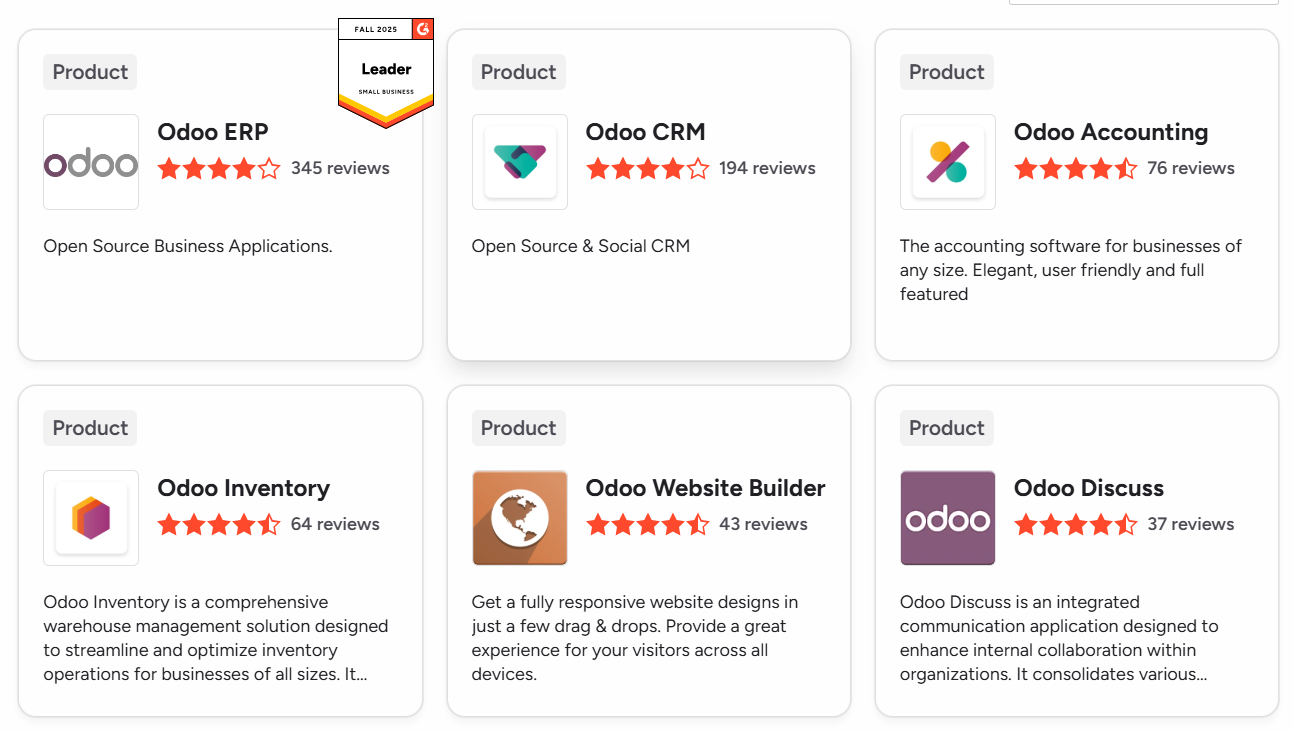
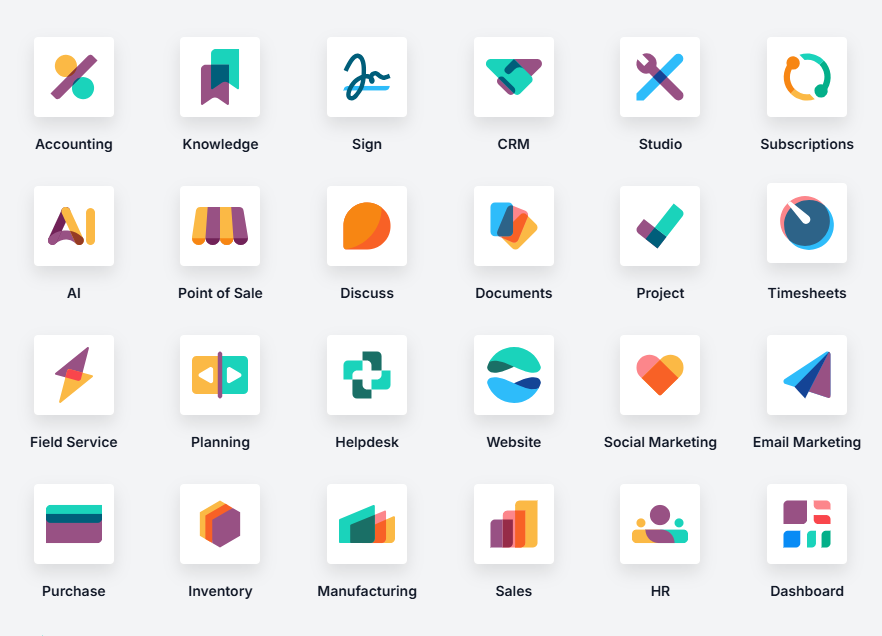
Odoo is a universal ecosystem where over 80 official modules work together as one team. At the system's core lies a powerful AI-CRM for sales management, intelligent warehouse accounting with auto-replenishment rules, and a flexible finance module adapted to local markets. As a result, you can automate the entire process — from the moment a client first calls to product delivery.
The main advantage of this architecture is complete data synchronization in real time. When a client places an order through the built-in E-commerce, the system instantly reserves the product in the warehouse, creates a purchase request for missing components, and generates an accounting invoice. This approach eliminates confusion from manual data entry, minimizes errors, and gives the owner transparent analytics of the entire business.
Why Small and Medium-Sized Businesses Choose Odoo
1. Affordable Price
Traditional ERP systems (SAP, Oracle, Microsoft Dynamics) cost tens and hundreds of thousands of dollars for implementation. Odoo offers two options:
- Community Edition — free version with basic functionality
- Enterprise Edition — paid version from $17.90/user/month with advanced capabilities
For small businesses, this means starting with a minimal budget: 5 users × $18 = $90/month. Compare this with $50,000+ for SAP implementation.
2. Fast Implementation
Traditional ERPs are implemented over months, even years. Odoo can be launched in 2-4 weeks for a standard small business. Why? The system already has ready-made "out-of-the-box" processes that suit 80% of companies.
3. Real-Time Interaction
Copy-pasting between different programs is a thing of the past. In Odoo, a client from CRM automatically enters the sales module → Sale automatically creates an entry in accounting → Warehouse shipment automatically writes off goods. Everything is interconnected.
4. Intuitive Interface
Odoo looks like a modern web application (similar to Google Workspace or Trello), not like a Windows 98 program. Employees get used to the system in days, not weeks. This is critically important for small businesses that don't yet need a separate IT department.
5. Flexibility
Start with CRM for 3 managers. A year later, add warehouse. Another year later — e-commerce and marketing. Odoo grows with your business. You don't need to change systems when scaling.
6. Open Source
Odoo Community Edition is open source. This means:
- You're not tied to one vendor
- The system can be customized for any specific needs
- A huge community of developers creates additional modules
- Complete transparency: you see how the system works "under the hood"
7. Global Partner Ecosystem
Odoo has over 5,000 official partners worldwide. In Ukraine, EU countries, and the MENA region, certified integrators (like Graz.tech) work to adapt the system to local specifics.
Odoo Implementation in Ukraine
In Ukraine, Odoo became particularly relevant after the full-scale Russian invasion in 2022. Many businesses began actively seeking solutions independent of Russian software and abandoning 1C/BAS. Odoo became a convenient alternative: European product (Belgium), open source code, powerful localization, and an active partner community.
In recent years, a strong Odoo ecosystem has formed in Ukraine — Odoo Days conferences are held, the OSA Ukraine public association operates, specialized "Accounting for Ukraine" solutions have emerged, and the number of implementations and partners is steadily growing. Today, Odoo is considered a reliable tool for digital transformation of Ukrainian businesses during wartime and post-war recovery.
Graz.tech is an official Odoo partner in Ukraine specializing in implementing ERP solutions for retail, e-commerce, and logistics in Ukraine, the EU, and MENA regions. Since 2019, we have completed 100+ projects for companies from small businesses to regional market leaders. More about us →
Would you like to learn more and give Odoo a try?
Briefly describe your business and goals. We will get back to you within 24 hours.
Odoo vs Competitors: Brief Comparison
Odoo vs SAP Business One
SAP wins:
Deeper functionality for large corporations
More ready-made integrations with banks and government systems
Odoo wins:
5-10 times lower total cost of ownership
Faster implementation (weeks vs months)
More modern interface
Easier to customize
Conclusion: For small and medium-sized businesses, Odoo is the better choice in terms of price-quality ratio.
Odoo vs Microsoft Dynamics 365
Dynamics wins:
- Deeper integration with Microsoft ecosystem (Office 365, Azure)
- More powerful capabilities for enterprise segment
Odoo wins:
- Significantly lower price (3-4 times)
- Simpler to use
- Faster implementation
- Greater flexibility in customization
Conclusion: If you're already deeply integrated into the Microsoft ecosystem — Dynamics makes sense. Otherwise, Odoo saves you money.
Odoo vs Cloud Solutions (Salesforce, HubSpot, QuickBooks separately)
Many companies use a "stack" of separate services: Salesforce for CRM, QuickBooks for accounting, Shopify for e-commerce, etc.
"Stack of services" approach wins:
- Each tool is a leader in its category
- You can choose the best for each function
Odoo wins:
- No integration problems — everything in one system
- Single database — complete business picture
- Lower total cost
- Easier to train staff (one system instead of five)
Conclusion: If you need 3+ different tools, Odoo will unite them and save you money.
Which Businesses Is Odoo Best Suited For?
If you have a store (or chain of stores), Odoo provides:
- Real-time warehouse accounting
- POS (point of sale system) with offline mode
- Customer loyalty programs
- E-commerce integration
For wholesalers, these are critically important:
- Multi-level price lists (different prices for different customer categories)
- Accounts receivable control
- Fast processing of large order volumes
- Logistics and delivery routing
Odoo covers all these needs "out of the box."
The MRP module allows you to:
- Plan production based on sales forecasts
- Optimize raw material procurement
- Control quality at all stages
- Calculate product cost
For IT companies, consulting, agencies:
- Employee time tracking
- Project management
- Billing based on hours spent
- Project profitability analytics
Odoo is the ideal choice for companies selling both online and offline:
- Unified product accounting across all channels
- Product reservation for online orders
- Click-and-collect (ordered online, picked up in store)
- Unified CRM database for all clients
Conclusion: Is It Worth Investing in Odoo?
Odoo is not just an ERP system. It's a comprehensive platform that can replace dozens of separate tools and unite all business processes.
Odoo is worth choosing if:
- You're a small or medium-sized business that has outgrown Excel and chaotic Google Sheets
- You're tired of a digital zoo with a dozen different programs
- You want to see the complete business picture in real time
- You need a system that grows with you
- You're looking for optimal functionality/price ratio
Based on our experience implementing Odoo in dozens of companies of various sizes, the system pays for itself on average in 6-12 months through:
- Saving employee time (routine automation)
- Reducing errors (manual data entry minimized)
- Better control (management sees all processes)
- Faster growth (system doesn't slow down development)
If you want to learn more about how Odoo can transform your business, contact us. We'll conduct a consultation and show the system in action with examples from your industry.
Ready to start your digital transformation journey?
Briefly describe your business and goals. We will get back to you within 24 hours.